
A parcel locker five minutes from home is now part of how patients in Singapore get their medicines, and SS 644:2025 sets the rules that keep that delivery safe.
Picture a caregiver finishing a late shift. Her father’s six-monthly prescription is ready, but the polyclinic pharmacy has closed, and nobody will be home for a doorstep delivery tomorrow. Today, a text message with a PIN tells her the medicine is waiting in a locker at the void deck downstairs. She collects it on her way up. For a growing number of patients and caregivers, this is how medication now reaches them. Behind that small convenience sits a national standard: SS 644:2025 – Medication delivery.

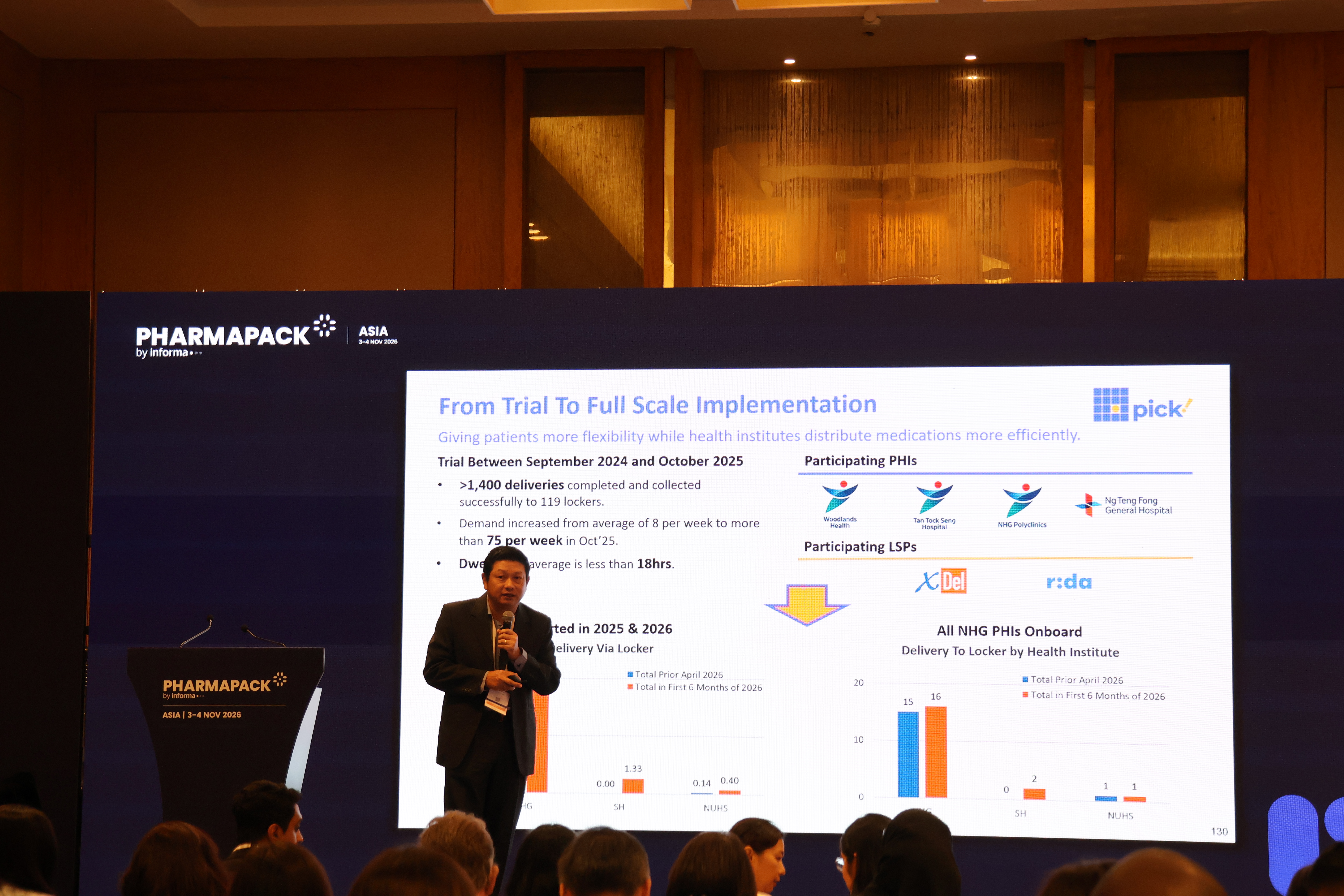
At Pharmapack Asia 2026 on 04 November 2026 at Marina Bay Sands, organised by Pharmapack, Mr New Soon Tee, Chief Executive Officer of Pick Network Pte Ltd, presented From Standard to Street: How SS 644:2025 Enables Safe Medication Delivery at Scale. He traced how locker-based medication delivery went from a survey and a temperature study to a service used by public healthcare institutions (PHIs) across the country, and how the revised standard gives everyone in the chain a common reference.
A Locker Within Five Minutes’ Walk
Pick Network runs a nationwide parcel locker network, and its vision is a world of seamless deliveries. Mr New pointed out a detail in the company’s logo: the exclamation mark points to the five-minute mark on a clock, because every Pick locker station is meant to be within five minutes’ walk of home. Most lockers sit under HDB void decks or in open community spaces such as community clubs and transport nodes, which makes them well suited to self-collection of medication.
The process is simple for the patient and fully tracked behind the scenes. The patient chooses locker delivery, the pharmacy sends the order details to the logistics service provider (LSP), and the LSP books a locker compartment and drops off the parcel. An interoperability platform then sends the patient a notification with a collection PIN and confirms when the parcel has been collected. Every step is recorded, so the medicine can be tracked from pharmacy to patient.

Benefits for Every Link in the Chain
For patients and caregivers, lockers are open round the clock, so there is no queue at the pharmacy and no waiting at home for a delivery window. Parcels are kept away from curious neighbours, passers-by and pets, and are protected from rain, direct sun, renovation dust and floor washing. Caregivers can also receive live updates and collect medication on behalf of the person they care for.
For healthcare institutions, the lockers are fail-close, so medication stays locked if anything goes wrong, and they are fitted with CCTV, front cameras and presence sensors. Only a mobile number and a locker location are needed, and status updates happen automatically. If a delivered medicine is recalled, collection can be blocked remotely. Locker delivery also eases the load on onsite pharmacies at a time of rising demand and shortages of pharmacists and delivery staff.
For logistics service providers (LSPs), lockers remove the uncertainty of doorstep delivery. Failed deliveries and re-delivery arrangements fall, drivers and vehicles go further during peak seasons, and notifications go automatically to the intended recipient only.
What Patients Said, and What the Thermometers Showed
The work began by listening to patients. A 2021 online survey of patients and caregivers found strong interest in collecting medicines from lockers, especially lockers in HDB estates and shopping malls. Respondents said convenience of location and timing mattered most, along with the chance to speak with a pharmacist when needed. Many saw locker collection as a practical alternative to queueing at the pharmacy or waiting at home for a delivery slot.
The obvious question for a medicine left in an outdoor locker is heat. Between 16 February and 14 April 2023, temperature loggers were placed in 122 lockers, about 12% of the network, chosen for their proximity to PHIs. The results were reassuring. Seventy-seven per cent of the lockers had a mean kinetic temperature below 30°C, none exceeded 40°C at any point, and the highest reading recorded was 36.3°C, for less than 5% of the time. Collection was also fast: 46% of parcels were collected within six hours, 70% within 12 hours, and 99% within 72 hours. Because most parcels are collected the same day, the risk of improper temperature exposure or returns is minimal.
What Changed in SS 644:2025
Mr New described SS 644:2025 as a framework that removes ambiguity. It gives pharmacies, institutions and LSPs a common reference, sets out procedures that protect the efficacy and safety of medication, and supports a wider choice of delivery modes for patients.

He highlighted five key amendments from the 2019 edition:
- Expanded scope. Controlled drugs are no longer excluded. The standard now gives guidance on handling, packaging, storing and delivering them.
- A risk-based approach to temperature. “In transit” is now clearly defined as the period from when the LSP receives the medication until it reaches the customer or is returned to the pharmacy.
- Enhanced packaging. Outer packaging must protect the inner packaging from damage and unsuitable conditions. Cold-chain items are packed separately, and parcels containing controlled drugs must carry clear handling instructions.
- A new delivery option. Authorisation to Leave (ATL) allows a parcel to be left unattended, but only with documented customer consent. It does not apply to controlled drugs or cold-chain items.
- Stronger records and exception management. Delivery records are kept for two years (three for controlled drugs), with new requirements for reporting delivery errors, lost medication and personal data breaches.
From Trial to Full-Scale Implementation
A trial from September 2024 to October 2025 delivered well over a thousand medication parcels to lockers across the island. Weekly demand grew several-fold over the trial, and most parcels were collected within the same day.
The service has since moved to scale. All National Healthcare Group (NHG) institutions are now onboard, and SingHealth and NUHS have started using it. Monthly delivery volumes have climbed steadily through 2026, and hundreds of lockers have been enabled for medication collection, most of them serving patients in the central region. NHG also piloted its own locker at Serangoon Polyclinic in November 2025, with more planned.
There is room to grow. Only some of the approved delivery vendors are integrated with Pick lockers so far, and volumes are expected to rise as more come on board. If SingHealth and NUHS enable lockers in their regions, the service could reach patients nationwide.
Built with Healthcare Partners

Mr New stressed that the service has been shaped by working closely with PHIs and LSPs. Changes made in response to their feedback include bringing the final collection reminder forward from 72 to 48 hours, which improves collection rates and lets institutions reroute a parcel to doorstep delivery sooner when needed. Patients can now choose a compartment at a height that suits them. Pick has also developed a purpose-built locker designed to operate within healthcare premises.
Looking Ahead
Mr New closed with a call to action. He urged healthcare institutions to offer delivery and collection options that fit each patient’s needs, rather than a one-size-fits-all approach. He encouraged LSPs to build their medication delivery capability and integrate with Pick’s network to meet growing demand.
“Deliver medicine and pharmacy care services where, when, and how patients need it.” – Mr New Soon Tee, Chief Executive Officer, Pick Network Pte Ltd
The journey from SS 644:2019 to SS 644:2025 shows what a standard can do when it is put to work. It gave institutions, logistics providers and technology partners shared rules to build on, and it is now helping thousands of patients get their medicines safely, conveniently and close to home.
SS 644:2025 – Medication delivery is available from the Singapore Standards eShop.