
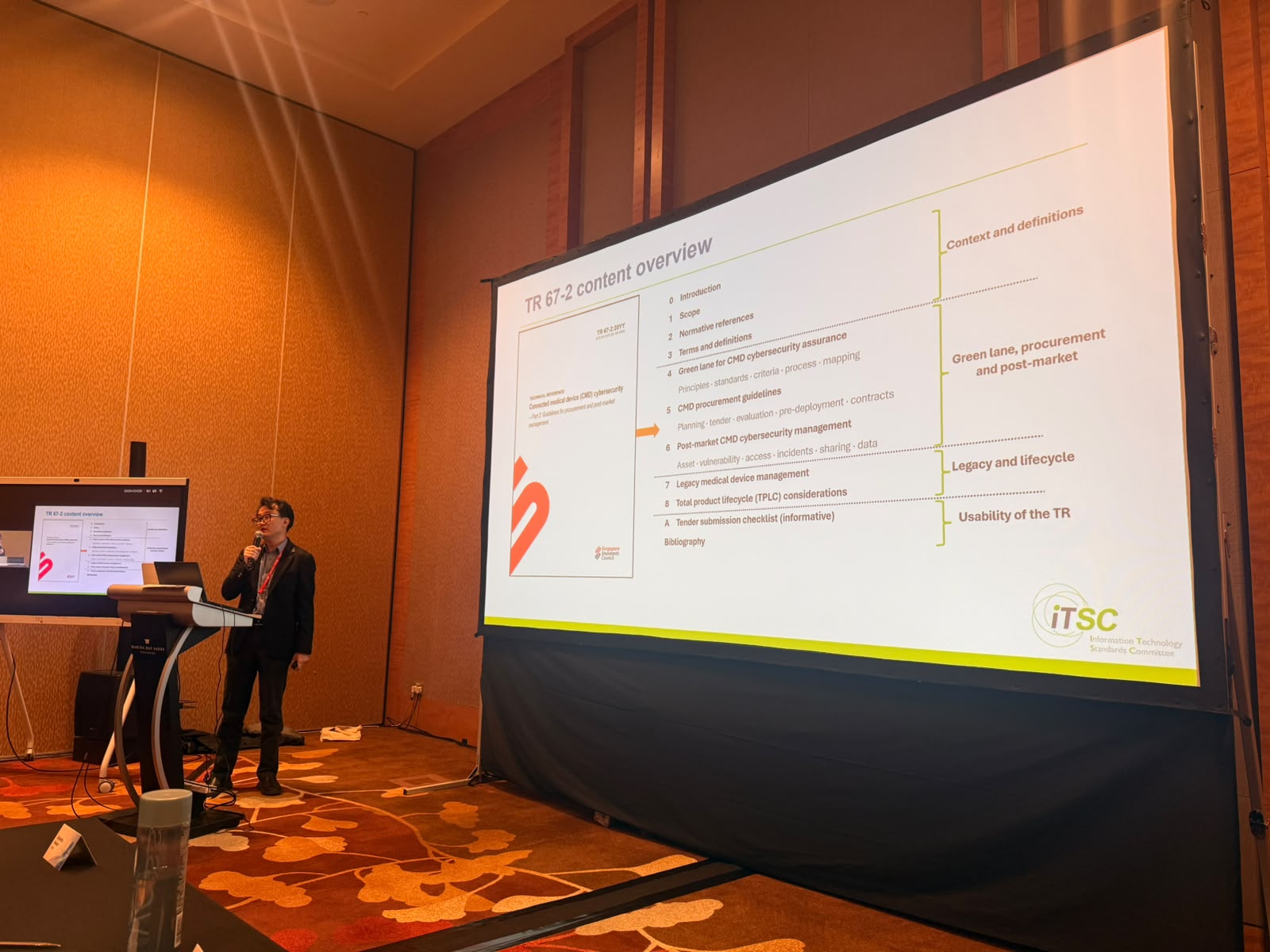
In October 2026, Singapore’s update on standards for emerging technologies was provided at two events held a week apart in Singapore: the International Cybersecurity Assessment and Certification Forum (ICAC) and the 26th Regional Asia Information Security Exchange (RAISE) Forum. At both, Dr Melvyn Kuan presented the ongoing revision of TR 67 on connected medical device cybersecurity.
ICAC: Building Trust in Emerging Technologies
On 14 October 2026, BSI and the RAISE Forum co-organised ICAC, a forum held physically in Singapore and online. Its theme was advancing cybersecurity assurance, certification and trusted market access in the age of AI and emerging technologies.

Regulators, standards bodies, certification organisations and industry leaders discussed how greater international alignment on standards, product and service evaluation, and conformity assessment can build that trust at scale, while streamlining processes, reducing cost and duplication, and shortening the time to market.
Dr Melvyn Kuan, Deputy Chair of the Security and Privacy Standards Technical Committee (SPSTC), presented “Catalysing secure adoption of disruptive technologies through standards & guidelines: Singapore’s update“. As the Deputy Chair of SPSTC, Dr Kuan supports the development and adoption of information security and privacy standards in Singapore. He also served as Editor of ISO/IEC 27404, published in 2025, which sets out a cybersecurity labelling framework for consumer IoT products, and contributes Singapore’s perspectives to international cybersecurity standards as a member of ISO/IEC JTC 1/SC 27 WG4. His talk at ICAC included the revision of TR 67on connected medical device (CMD) cybersecurity.
The 26th RAISE Forum
RAISE was established in 2004 as a focal point for the Asian standardisation community on information security. It gives members a place to share strategies, policies and lessons learnt. It also helps ensure that Asia’s needs are reflected in international standards work and that regional efforts do not duplicate work done elsewhere.

The 26th RAISE Forum took place on 20 and 21 October 2026 at Holiday Inn Singapore Atrium and online. It brought together standards experts, researchers and industry representatives from Singapore, Japan, Korea, China, Malaysia, the Philippines and Hong Kong SAR, along with ISC2 Asia Pacific, Asia-ISAC and Huawei. Day 1 was given to status updates from international standards bodies and member economies. Day 2 opened with Singapore’s update, presented by Dr Kuan, which gave delegates a look at the TR 67 revision.

Revising TR 67
First published in 2018, TR 67:2018 gave healthcare institutions guidance on securing connected medical devices during procurement and operations. Since then, connected devices have become more pervasive in care settings, and the Cybersecurity Labelling Scheme for Medical Devices, CLS(MD), was introduced in 2022.
The revision builds on the 2018 edition and extends it across the full device lifecycle. The revised TR 67 would be issued in two parts:
- TR 67-1: Guidelines on CMDs for manufacturers
- TR 67-2: Guidelines for procurement and post-market management
What the Revision Sets Out to Do
Part 1 is intended to give manufacturers a clearer cybersecurity reference for designing, developing and testing connected medical devices, aligned with existing cybersecurity labelling initiatives. Part 2 is intended to support healthcare providers, procuring entities and regulators as they buy, deploy and manage these devices, including older devices that are no longer fully supported. Among its features is a “green lane” approach, which aims to reduce duplicated testing during procurement by recognising existing assurance evidence.
The revision is aligned with international references such as IEC 81001-5-1, IEC TR 60601-4-5 and ISO 14971, as well as with CLS(MD) and HSA’s regulatory guidelines for software medical devices.
CoRE-SDO’s Role
TR 67 lies in the convergence of healthcare and cybersecurity. Through its involvement in the revision, CoRE-SDO brought the perspectives of Singapore’s biomedical and healthcare community into the revised document, for manufacturers, hospitals and regulators to adopt. Presenting the work at ICAC and RAISE gave regulators, certification bodies and standards experts from across the region an early view of Singapore’s direction. Further details will be provided when the revised TR 67 is published.
Looking Ahead
Once published, the revised TR 67 would give Singapore’s medical device makers, healthcare institutions and regulators a shared cybersecurity reference across the device lifecycle. Presenting the work at ICAC and RAISE also demonstrates Singapore’s commitment intends to collaborate with international partners for cross-recognition of best practices with the region and the world.
CoRE-SDO thanks BSI and the RAISE Forum for organising the two events, andthe opportunities to profile the ongoing work of revising TR 67.