
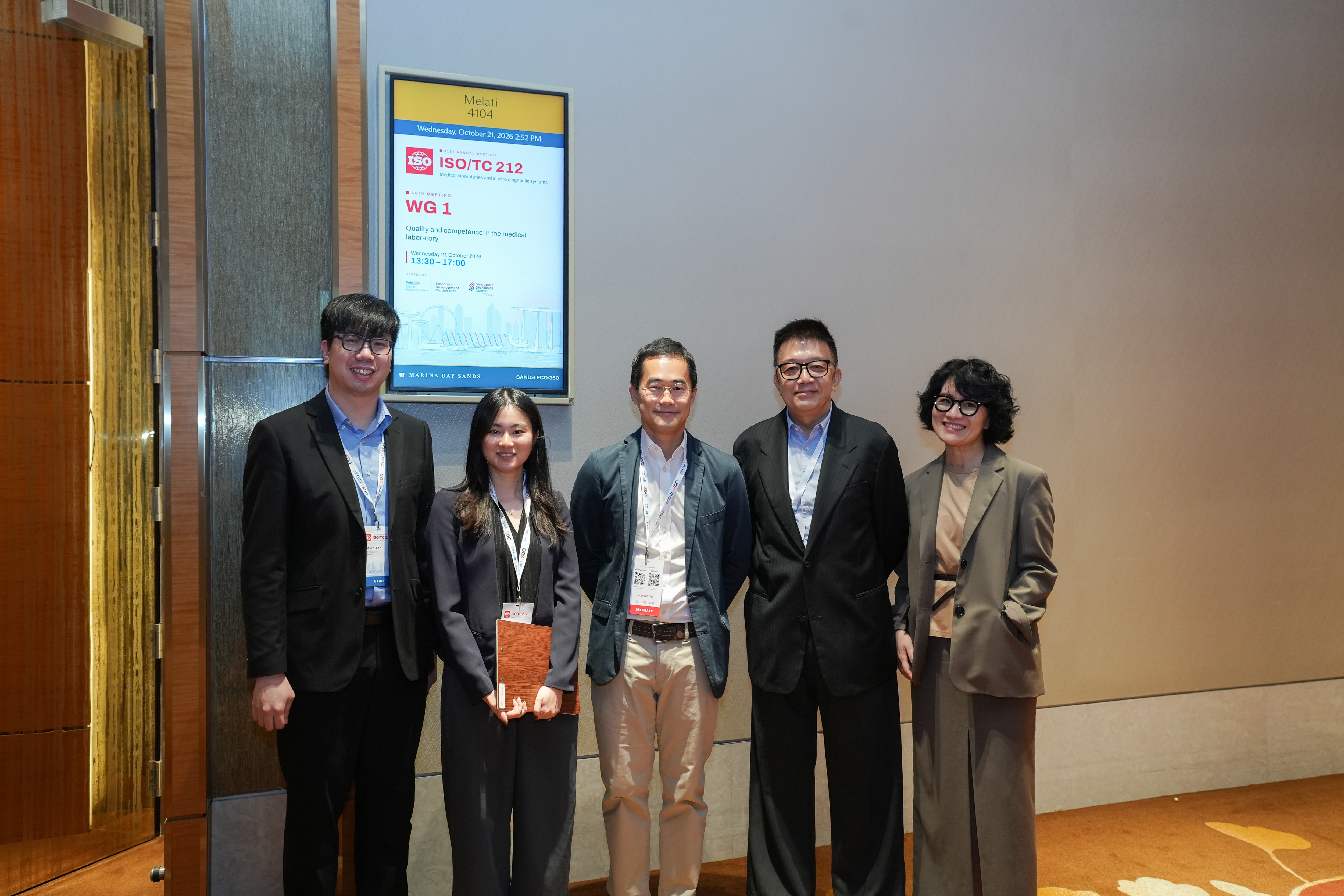
From 20 to 22 October 2026, international experts in medical laboratories and in vitro diagnostic systems convened in Singapore for the 31st ISO/TC 212 Plenary and its associated working group meetings.
A significant outcome for Singapore was the endorsement of its new project proposal, Medical laboratories — Resource stewardship and environmental sustainability, to proceed to the New Proposal (NP) stage at ISO. The proposal is spearheaded by Dr Mark Lum, Consultant Chemical Pathologist at KK Women’s and Children’s Hospital, and builds on his article, ‘Integrating Sustainability into ISO 15189’, published earlier this year in the Annals of Laboratory Medicine.
From proposal to resolution

Dr Lum presented the proposal at the meeting of Working Group 1 (WG 1), Quality and competence in the medical laboratory, where it received unanimous support and positive comments, including by experts from Australia, Canada, Iran, Japan, the Netherlands and the United Kingdom. At the closing plenary, ISO/TC 212 adopted the recommendation:
ISO/TC 212 accepts the WG1 recommendation that Dr. Mark Lum’s project proposal Medical laboratories – Resource stewardship and environmental sustainability advances to the proposal stage (NWIP submission).
The proposed deliverable is a Technical Specification (TS) intended to serve as a companion document to ISO 15189. Its aim is to help laboratories prevent avoidable resource consumption and waste, and contribute to environmental sustainability, without compromising examination quality, patient safety, clinical appropriateness or continuity of service.

Addressing a gap in ISO 15189
ISO 15189 sets out the internationally recognised requirements for quality and competence in medical laboratories. It does not yet provide guidance on managing avoidable resource use, preventable waste or the associated environmental impact.
At the same time, interest in laboratory sustainability is growing. This is reflected in initiatives such as the EFLM Task Force on Green and Sustainable Laboratories, LEAF and My Green Lab, as well as in evolving procurement requirements in jurisdictions such as the United Kingdom and the European Union, where sustainability considerations are becoming increasingly prominent. These frameworks, however, are not integrated with ISO 15189 and vary in scope and assessment criteria. Laboratories therefore lack a common ISO-based framework for building resource stewardship into their quality management systems.
The proposal also reflects the committee’s broader direction. At the opening plenary, ISO/TC 212 Chairperson Mr Jesús Rueda Rodríguez had spoken about how climate change would become an increasing area of attention for the committee.

Looking ahead
The proposal will now be circulated to the ISO/TC 212 P-members for an NP ballot, marking the next important step in its progression within ISO. Approval will depend on P-members voting consensus, together with their active support through the nomination of experts, before the project formally enters the ISO pipeline.
This will create an important opportunity to advance practical ISO guidance on resource stewardship and environmental sustainability in medical laboratories. The next WG 1 meeting, to be held in Sydney, Australia, in April 2027, is expected to provide further updates for this work.
Singapore and international experts in medical laboratory practice, quality management and related fields who are interested in contributing to the development of this Technical Specification are welcome to get in touch with CoRE-SDO [Nomination link].