
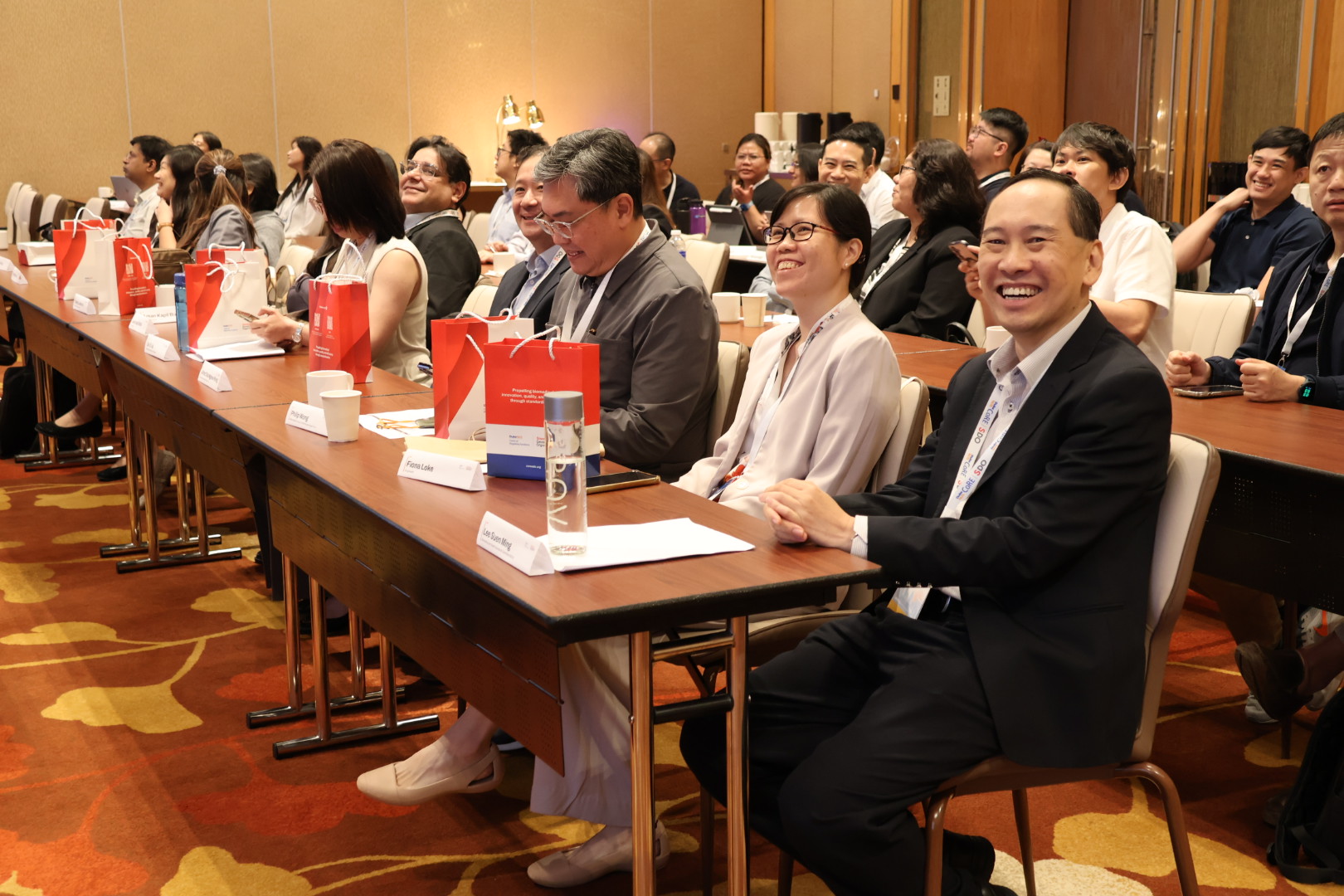
From a wearable patch that tracks heart rhythm to software that reads retinal scans for signs of disease, a growing number of medical devices are now being designed and tested in Singapore. Before any of them reaches a patient, it must go through a clinical investigation, and the strength of that investigation depends on how well its evidence is prepared and reviewed. On 20 October 2026, that work came into sharp focus as clinicians, researchers, ethics committee members, regulators and industry partners gathered at Marina Bay Sands, with many more joining on Zoom, for the official launch of TR 151:2026 – Clinical Investigation of Medical Devices.


Organised by the Centre of Regulatory Excellence – Standards Development Organisation (CoRE-SDO), the afternoon was opened by Mr Lee Suen Ming, Chair of the Biomedical and Health Standards Committee (BHSC), who officially launched the Technical Reference. Speaking on why clinical investigation standards matter for Singapore, he made the case that a thriving medtech ecosystem depends on evidence that sponsors, investigators and ethics committees can all trust. He encouraged hospitals, ethics committees and medtech companies to put TR 151 to work in the planning and review of their studies. A short CoRE-SDO video then traced how a Singapore Standard travels from an identified need to a published document.
Where TR 151 Fits in the Global Picture

Our guest speaker, Dr Susan Partridge, Clinical Regulatory Lead at the British Standards Institution (BSI), joined online to set the international context. She introduced ISO 14155 as the global benchmark for good clinical practice in medical device investigations, referenced by the EU Medical Device Regulation and already adopted in Singapore as SS ISO 14155:2020. The 2026 edition goes further, strengthening expectations on residual risks, data monitoring committees, missing data, estimands and subject follow-up.
Speaking from BSI’s vantage point as a notified body, Dr Partridge noted that the 2026 edition is already treated as current good practice, even ahead of formal harmonisation in the EU. TR 151 does not restate those principles. It is written as an extension rather than a replacement, supplying the device-specific “how much evidence” detail that the international standard leaves open.
“Trusted clinical evidence is built on a foundation of trusted standards.” – Dr Susan Partridge, Clinical Regulatory Lead, BSI
From Clinical Gap to Published Technical Reference

Ms Fiona Loke, Director of the SingHealth Medical Technology Office (MTO) and Convenor of TR 151, explained why the document was needed. In the past, most devices arriving in Asia had already been approved by the US FDA and proven safe elsewhere. Today, a growing wave of homegrown innovation means some development teams are encountering ISO 13485 and formal design controls for the very first time.
Yet the regulatory landscape had not kept pace. Drug trials follow ICH E6, while device trials fall under the Human Biomedical Research Act with no dedicated guidance standard, even though roughly one in ten SingHealth clinical trials involves an investigational medical device. As a result, submissions varied widely. Some arrived with little more than a product brochure, while others included full design files, and review panels had no common reference to assess them against.

Drawing on approaches from Australia’s TGA and the US FDA, the working group set out to strike a careful balance. Too little guidance would leave submissions and reviews inconsistent. Too much would create an evidence burden that could price out early-stage innovators or push them away from formal channels altogether. The answer was guidance proportionate to device risk and development stage, rather than a rigid checklist.
“A broad consensus guideline provides clarity for device innovators, investigators, industry partners and ethics committees, and balances diverse interests.” – Ms Fiona Loke, Convenor of TR 151
The Guidance Table in Action

Dr Yeo Jing Ping, Vice President, Clinical Solutions & Head, APAC at Precision for Medicine, joined online to show what TR 151 means for the teams that run studies day to day. At the heart of the document is a guidance table that maps device risk class and study stage to the expected levels of design control, testing, risk management and documentation.
To illustrate, she walked through a Class B device entering a traditional feasibility study. For this device, the table calls for partial QMS conformance, definitive preclinical safety testing, an FMEA aligned with ISO 14971 and a core set of documents. A single lookup tells the whole study team what evidence to prepare before the protocol is even drafted. For a CRO managing studies across many sponsors and sites, this consistency allows processes to be built once and reused with confidence.
“TR 151 doesn’t make device studies simpler. It makes them predictable.” – Dr Yeo Jing Ping, Precision for Medicine
The Right Evidence at the Right Time

Dr Philip Wong, Interventional Cardiologist at Raffles Medical Group and Founder of WEB Biotechnology, spoke for the innovators. He walked the room through the path to first-in-human studies, using examples that ranged from AI-enabled diabetic retinopathy screening software to a wearable ECG patch.

For the AI screening software, a higher-risk device entering a pivotal study, TR 151 points to ISO 13485 conformance, algorithm validation, software verification, cybersecurity and usability testing, and a full documentation set, with the algorithm locked before the investigation begins. For earlier-stage devices, the expectations are lighter. His message to start-ups was clear. Expectations scale with risk and stage, so partial ISO 13485 conformance is enough early on, with full certification expected only at the highest design control level. Preclinical testing can also be planned in stages rather than as one large effort.
“TR 151 doesn’t ask us to be a big company before we’ve proven the idea works – it asks for the right evidence, at the right time.” – Dr Philip Wong, Raffles Medical Group & WEB Biotechnology
Readiness at the Institution

Dr Alfred Chia, Deputy Director of the NUHS Research & Innovation Office, brought the institutional perspective. A mobile health app and a surgical implant are both medical devices, yet they call for vastly different evidence. Without a national reference, ethics committee members, many without engineering backgrounds, have had to make case-by-case judgement calls, and each institution has had to set its own bar for what counts as sufficient evidence.

TR 151 changes that. It gives institutions a shared basis for submission templates, reviewer training and early triage, so that device studies are better prepared before they reach the ethics committee. It also strengthens mutual recognition between CIRB and DSRB, turning it from an administrative formality into a genuinely comparable assurance.
“TR 151 doesn’t add bureaucracy – it replaces ambiguity. And for institutions, ambiguity has always been the real risk.” – Dr Alfred Chia, NUHS Research & Innovation Office
Panel Discussion – Putting TR 151 to Work

After a networking break, Ms Fiona Loke moderated a panel with Dr Aman Kapil Butta, Director, Clinical Affairs, APAC at Intuitive Surgical, Dr Philip Wong, Dr Alfred Chia and Dr Ooi Xi Jia, Global Quality & Accreditation Certification Lead at BSI.
The discussion opened with the role of TR 151 as a voluntary document. Panellists noted that it puts into practice what the HBRA expects in spirit, namely studies that are safe and ethically sound, so institutions that adopt it are better placed to demonstrate compliance. On concerns about additional paperwork, panellists observed that clearer expectations at the point of submission should reduce revision cycles and shorten approval timelines. The panel also cautioned that any standard risks becoming a checklist exercise, and that reviewer training and a strong review culture are what turn TR 151 into meaningful protection for participants.

Looking beyond Singapore, Dr Ooi Xi Jia explained how EU Notified Bodies assess the clinical evidence that device studies produce. While ISO 14155 remains the primary reference, data generated in line with TR 151 can give Notified Bodies greater confidence. Dr Aman Kapil Butta highlighted how devices, unlike drugs, often change mid-study, and how agreeing a decision tree upfront, from a simple documentation update to a fresh ethics application, keeps studies on track. Discussion also turned to multi-site trials, where a single national reference means a well-prepared submission should meet the bar at any adopting institution.
Built by the Community, for the Community

The afternoon closed with an appreciation of contributors and a group photograph. TR 151 was developed under the BHSC, with the support of the CoRE-SDO. A big thank-you to the working group members below for their dedication and expertise in making TR 151 possible.
Convenor
- Ms Fiona Loke Wei Ling (SingHealth)
Members
- Ms Tan Yun Ying (Medical Technology Office, SingHealth)
- Ms Iris Tan Siu Kwan (SingHealth)
- Ms Ong Siok Luan (SingHealth)
- Ms Beverly Liew (Health Sciences Authority)
- Dr Yeo Jing Ping (Precision for Medicine)
- Dr Alfred Chia Ngeow Khing (National University Health System)
- A/Prof Lim Thiam Chye (National University Hospital / NUS)
- Dr Wu Ruige (A*STAR)
- A/Prof Koh Kwong Fah (Woodlands Health, NHG)
- Dr Philip Wong En Hou (Raffles Medical Group / WEB Biotechnology)
- Dr Aman Kapil Butta (Intuitive Surgical)
- A/Prof Marianne Yap Ling Ling (Edwards Lifesciences)
- Ms Vilianty Luo Wen Ya (Medtronic Singapore Operations)
- Mr Sharad Manasvi Shukla (Asia Pacific Medical Technology Association)
Resource Members
- Prof Lawrance Ho Khek Yu (National University Health System)
- Ms Lyca Manembu (Medtronic Malaysia)
- A/Prof Tam C Nguyen (Monash Health)
- Dr Ooi Xi Jia (British Standards Institution Singapore)
- Dr Susan Partridge (British Standards Institution Group)
TR 151 is available from the Singapore Standards eShop. Its companion standard, SS ISO 14155:2026 – Clinical investigation of medical devices for human subjects – Good clinical practice, can also be found on the Singapore Standards eShop.