
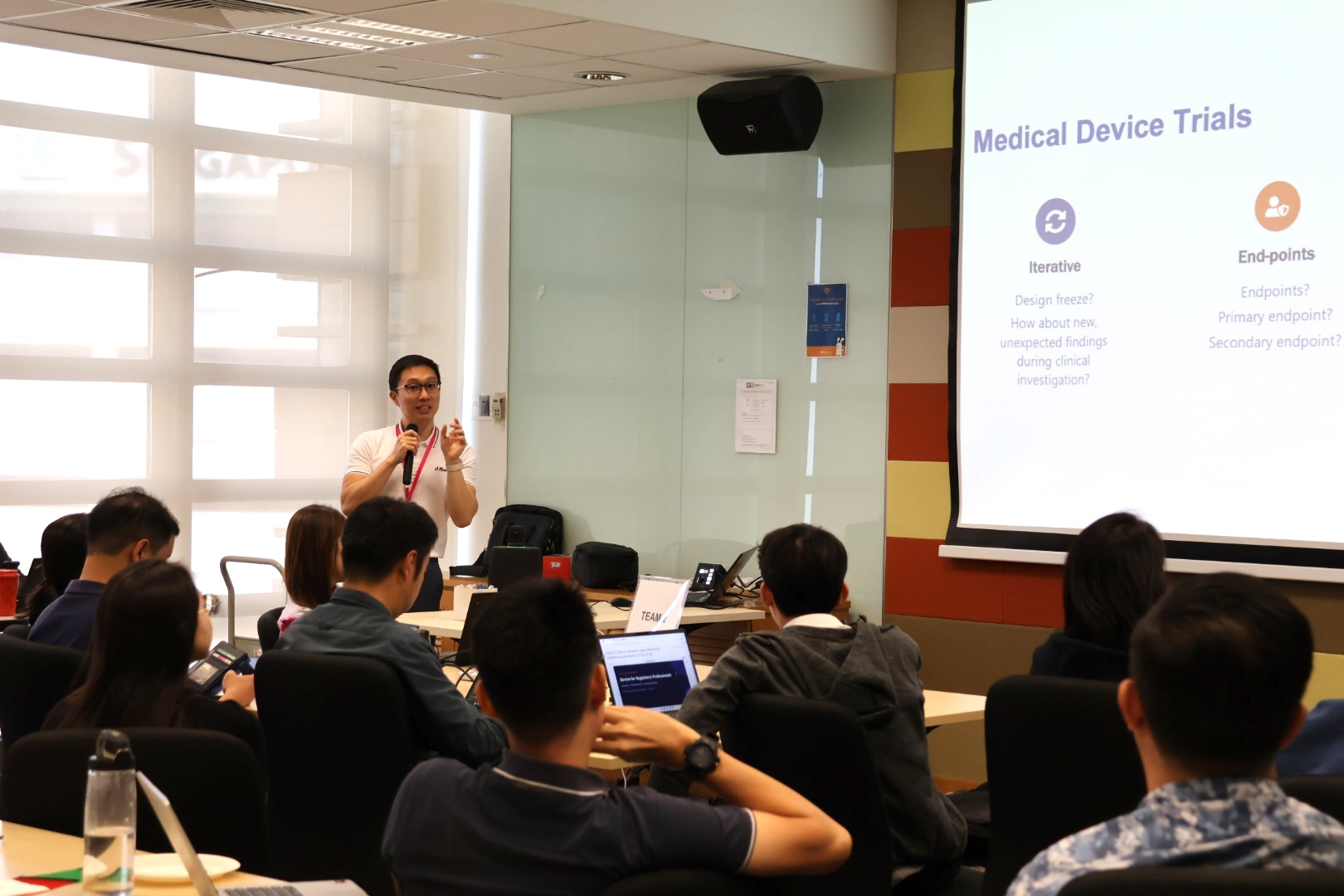
Good clinical evidence does not announce itself. It has to be built, claim by claim, endpoint by endpoint, and then read the same way by everyone who looks at it. That was the focus of Day 03 of Duke NUS Medical School’s GMS5008 module, Regulation and Clinical Evaluation of Medical Devices, held from 03 to 07 August 2026.
The day opened with two overview sessions on clinical evidence, one on medical devices covering ISO 14155 and clinical evaluation reports, and one on in vitro diagnostics covering ISO 20916 and ISO 23640, both delivered by speakers from the Health Sciences Authority (HSA). These set up the afternoon’s main event, Practicum I, Evaluating Clinical Datasets to Support Regulatory Decisions, which ran across two blocks with a short break in between.

The practicum brought together regulators from HSA and Dr Lim Yu Jing of Osteopore, who offered the industry perspective and also serves as Convenor of the National Mirror Working Group for ISO/TC 194 on Biological and Clinical Evaluation of Medical Devices (NMWG 194), with support from both CoRE Education and CoRE-SDO Teams. Bringing regulatory and industry perspectives into the same room for a single exercise was a deliberate choice, so that participants could hear how the same dataset gets read from each of these vantage points, in the same breath.
A Hypothetical Device, a Very Real Set of Questions
Rather than lecture through the requirements, the practicum handed participants a case: the H-Core Anchors, a fictional medical device built specifically for the exercise. Learners worked through a structured evaluation template, filling in the highlighted sections to assess the device’s clinical performance, safety, and clinical benefit based on the clinical data provided in the case background.
Day 3 closed with a dedicated hour led solely by Dr Lim on Clinical Evaluation Report, Review for Regulatory Professionals. This session was built around a single organising idea, the golden thread running from intended purpose, through claims and General Safety and Performance Requirements, to clinical endpoints, clinical data, and finally a benefit risk conclusion. Participants were pushed to trace this thread in both directions. Could a claim on the label be followed back to a dataset and a stated conclusion? And just as often, where does that thread actually break?


Across three working blocks, Product Claims, the Clinical Development Plan, and Clinical Investigation Design, participants deconstructed an overreaching marketing claim, built a staged evidence generation plan from a gap analysis, and critiqued a flawed pivotal study protocol riddled with the kind of design defects that come up again and again in practice. Single arm designs were asked to support comparative claims, endpoints measured the wrong thing, and follow up periods were too short for the durability being claimed. The debrief discussions repeatedly circled back to the same point. A well conducted study cannot make up for a design that was never built to answer the question being asked of it.
A Timely Update: The Revision of SS ISO 14155:2020
Alongside the practicum sessions, participants were also updated on standards development effort that sits close to Dr Lim’s own work as NMWG 194 Convenor, the revision of SS ISO 14155, Singapore’s national Good Clinical Practice standard for medical device clinical investigations.


The revision aligns Singapore’s standard with ISO 14155:2026, the newly published fourth edition of the international benchmark. The update introduces a sharpened definition of clinical performance, a new estimands framework for primary endpoints, strengthened informed consent provisions, restructured suspension and termination procedures, and expanded duties for Clinical Events Committees and Data Monitoring Committees, among other changes. With Singapore increasingly hosting trials destined for multi-jurisdictional submission across the EU, US and Asia Pacific, keeping the national standard in step with the base ISO document gives sponsors and sites a clearer, more consistent reference point to work from.
The revised standard is currently in its public comment period, running from August to October 2026, with publication targeted for October 2026.
TR 151: A New Local Reference Taking Shape
Separately, a local draft, TR 151, is currently in the pipeline for publication. TR 151 is built on the clauses of ISO 14155:2026, translating them into practical, device specific guidance for planning, designing and conducting clinical investigations of investigational medical devices.


Its scope covers the expected levels of design control, risk management, documentation and testing that should be demonstrated at the time of ethics review and approval, calibrated to the stage of device development and the risk class of the device concerned. In doing so, it gives ethics committees a consistent reference framework for reviewing submissions for such investigations, rather than leaving each committee to interpret ISO 14155:2026 independently. First in human studies that meet the definition of an early feasibility study are addressed within its scope.
Once published, both SS ISO 14155 and TR 151 will be available for purchase and download on the Singapore Standards eShop.
Why It Matters
Sessions like this one exist because clinical evaluation is too often taught, and practised, as a paperwork exercise rather than a design discipline. By running a shared exercise across regulator, industry and academic facilitators, and pairing that with visibility into the standards now taking shape behind the scenes, Day 03 of GMS5008 gave the next generation of regulatory professionals a clearer view of both ends of the process. The evidence sponsors must build, and the standard against which it will eventually be measured.

CoRE SDO thanks Dr Lim Yu Jing of Osteopore and the CoRE Education Team for the opportunity to contribute to this programme.