
From ensuring that a weighing scale at a supermarket checkout is accurate to calibrating the sensors that monitor air quality across a city, metrology touches virtually every regulated decision in modern society. On 14 May 2026, the World Metrology Day Conference brought that work into sharp focus, gathering industry practitioners, regulatory bodies, and technical experts under the theme “Metrology: Building Trust in Policy Making”.
Organised by A*STAR National Metrology Centre (A*STAR NMC), with co-organisers Health Sciences Authority (HSA) and CCS Weights and Measures Office (WMO), the conference featured distinguished keynote speakers who addressed standards and conformance as drivers of industry trust, the regulatory principles underpinning fair trade, and how rigorous carbon measurement, reporting, and verification supports Singapore’s net zero commitments.
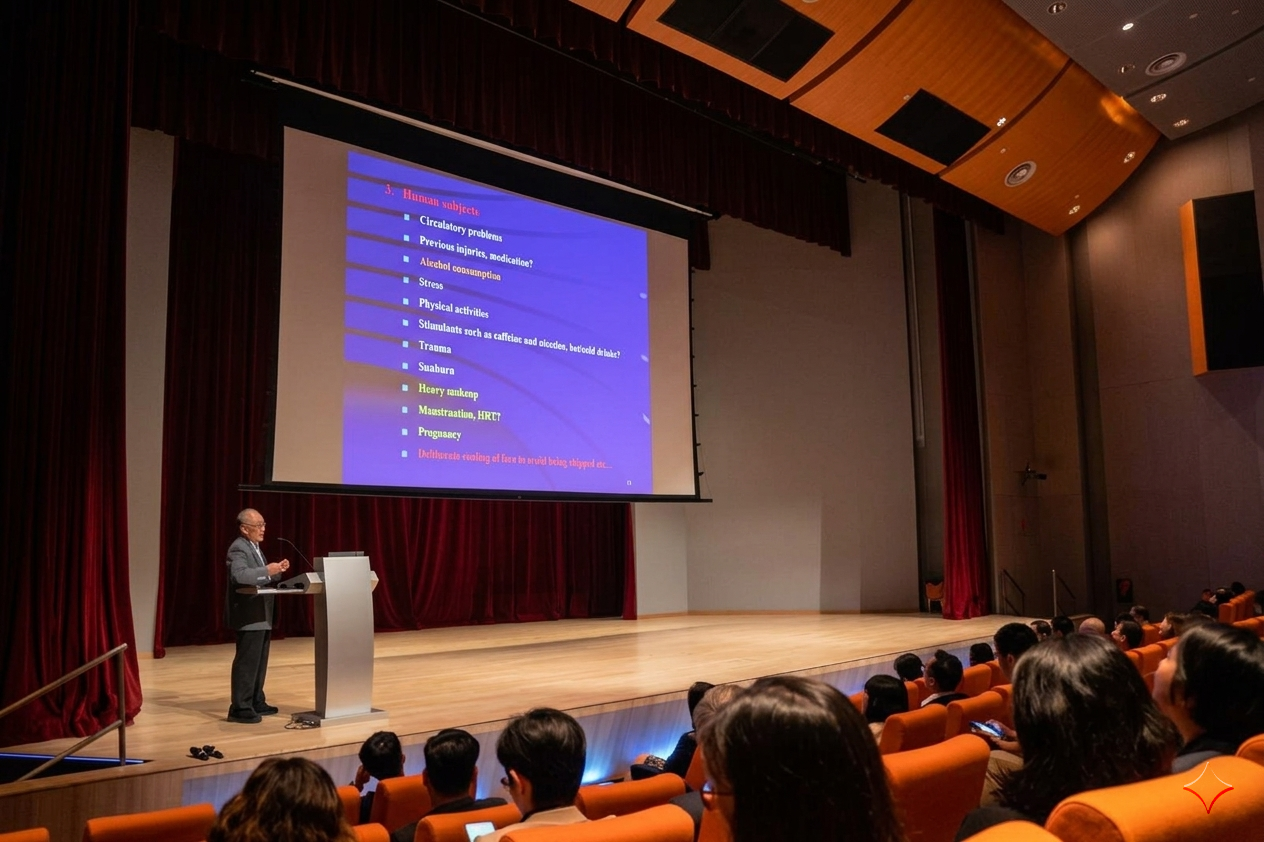
Against this backdrop, Prof Eddie Ng Yin Kwee of Nanyang Technological University (NTU) took to the floor to deliver a presentation that brought the stakes of measurement directly into the clinic and the checkpoint: Applied Thermography for Fever Identification and Updates on Infrared (IR) with AI for Other Health Abnormalities: Facts and Myths in Reflecting Deeper Metabolic Activity.
A Hard Lesson from the SARS Era

Prof Ng opened with a historical grounding that was equal parts sobering and instructive. When SARS swept through Asia in 2003, IR thermal imagers were rapidly deployed at border checkpoints and hospital entrances with minimal scientific validation. The intention was sound: SARS’s cardinal symptom is high fever, and IR cameras offered a non-invasive, high-throughput screening method. The execution, however, was widely criticised.
Reports from across the region questioned whether the scanners were fit for purpose. One European thermography instructor memorably characterised the effort as achieving “purely political” success, effective as psychological reassurance but falling short of its clinical mandate.
“The regret is that we could have done a much better job of actually finding cases if the methodology had been correct.”
For Prof Ng, this episode is not merely history, it is the founding argument for why Singapore’s SS 582-1:2020 and SS 582-2:2020 exist. Standards like these are the direct institutional response to what happens when policy outpaces metrology.
SS 582-1 and SS 582-2: Singapore’s Answer to a Global Gap

Singapore’s contribution to global metrology in this domain is substantial and traceable. Prof Ng walked attendees through the development trajectory that culminated in the current two-part standard. The lineage stretches back to Technical Reference TR 15-1 (2003) and TR 15-2 (2004), developed in the immediate aftermath of SARS when almost no equivalent international guidance existed.
The 2020 revision elevated this work to full Singapore Standard status. SS 582-1 specifies requirements and test methods for thermal imagers used in human temperature screening, covering critical parameters such as temperature range, display resolution, detector pixel count and measurement accuracy. SS 582-2 addresses implementation: how to plan a screening site, set up and operate the system, interpret results, train operators, and maintain the equipment through routine checks, periodic calibration, and proper storage.
Together, the two parts form an end-to-end framework that transforms IR screening from an improvised response into a disciplined, auditable process. Prof Ng served as co-convenor on the working group for SS 582, alongside partners from industry, government agencies, and healthcare institutions.
What makes this framework necessary becomes clear when one appreciates the complexity of the measurement itself. An IR imager does not measure core body temperature, it captures skin surface temperature, which is influenced by a cascade of variables: the subject’s circulatory health, recent physical activity, alcohol consumption, emotional stress, ambient airflow, relative humidity, the camera’s drift characteristics, and even whether the person is wearing a cap or spectacles. SS 582-1 and SS 582-2 exist precisely to account for this complexity, turning it from an uncontrolled source of error into a managed, documented set of conditions.
Beyond Fever: Where IR Research Is Heading
Prof Ng also shared findings from three research programmes that illustrate how the rigour demanded by SS 582-1 and SS 582-2 applies equally as IR thermography expands into new clinical territory and what happens when that rigour is absent.
The first explored whether thermal imaging of forearm veins could indicate blood pressure. The findings were inconclusive, underlining why rigorous measurement protocols, as set out in SS 582-1, must be established before clinical applications can be claimed.
The second mapped heat patterns across the bald scalp, showing how blood vessels beneath the skin surface affect temperature readings. The wide variation observed between individuals reinforced a core principle of SS 582-2, that trained operators and controlled environments are essential, not optional.
The third applied AI and physical laws together to detect breast cancer through IR imaging. The NTU team’s model was able to identify tumour locations from skin surface temperatures, offering a portable and affordable alternative to conventional mammography.
Taken together, these case studies make a consistent argument: the promise of IR-based health monitoring is only realisable when the measurement foundation is sound. That is precisely what SS 582-1 and SS 582-2 provide for the fever screening domain.
Metrology as the Guarantor of Trust
The hantavirus concern of May 2026, referenced in Prof Ng’s slides as a contemporaneous example, is a timely reminder that infectious disease threats do not wait for measurement frameworks to mature. When an IR imager drifts without correction, when an operator is untrained, when a screening site has excess humidity or a stray airflow, the readings produced are unreliable in ways invisible to the policymaker depending on them.
SS 582-1 gives procurement officers and equipment manufacturers a clear, testable specification so that a thermal imager deployed at any port of entry or clinical setting meets a consistent performance bar. SS 582-2 gives operators and facility managers the procedural scaffolding to deploy that equipment correctly and with documented confidence. Together, they translate decades of scientific inquiry into an auditable package that policymakers can cite when asked: how do we know the screening is working?
That is what trust in policy-making looks like at the measurement level and it is the contribution Singapore brought to the world stage on 14 May 2026.
Organisations seeking to procure, deploy, or evaluate thermal imaging systems for health screening are encouraged to reference SS 582-1 for equipment specifications and test methods, and SS 582-2 for site planning and operational implementation.
Looking Ahead
A/Prof Ng concluded with a forward-looking note. As AI and affordable IR technology open doors to new medical applications, the need for robust standards, well-trained operators, and reliable equipment remains constant. The work behind SS 582-1 and SS 582-2 is not just relevant today; it sets the benchmark for what comes next.
For Singapore’s metrology and standards community, World Metrology Day 2026 served as both a celebration of how far the field has come since the SARS-era IR deployments – a journey embodied in the rigour of SS 582-1 and SS 582-2 – and a clear-eyed acknowledgement of how much careful, exacting work remains to be done as AI, affordable IR hardware, and new clinical applications converge.